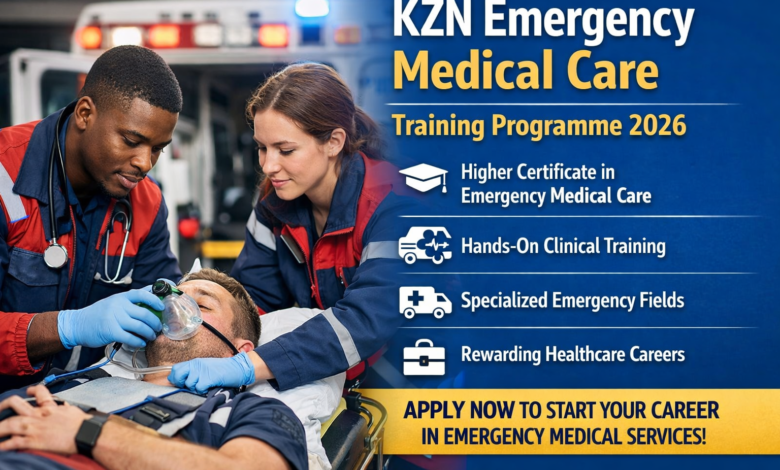
The KwaZulu-Natal Department of Health offers the KZN Emergency Medical Care Training Programme, an important initiative designed to train skilled emergency medical personnel who can respond to accidents, medical emergencies, and disasters across the province. This programme plays a crucial role in strengthening South Africa’s emergency healthcare system by preparing students for careers in ambulance services, rescue operations, and hospital emergency departments.
Emergency medical professionals are the first responders who provide life-saving care before patients reach hospitals. Through structured education and practical training, the KZN Emergency Medical Care Training Programme equips students with the knowledge, technical skills, and professional discipline required to handle critical medical situations.
Purpose of the Programme
The main goal of the programme is to develop competent emergency care providers who can deliver rapid and effective medical assistance. Students learn how to assess patients, provide basic and advanced life support, manage trauma cases, and safely transport patients to healthcare facilities.
The training is often conducted through accredited institutions such as the KwaZulu-Natal College of Emergency Care, which operates under the provincial health department and is regulated by the Health Professions Council of South Africa.
Graduates from the programme contribute significantly to ambulance services, disaster response units, and community health services.
Qualifications Offered
The KZN Emergency Medical Care Training Programme provides several qualifications designed to suit different levels of experience and career goals. These qualifications include:
1. Higher Certificate in Emergency Medical Care
This is an entry-level qualification for individuals who want to start a career in emergency medical services. The course typically runs for one year and focuses on the fundamentals of pre-hospital emergency care.
Students learn basic life support techniques, patient assessment, and safe ambulance operations. After completion, graduates can work as ambulance emergency assistants or basic life support practitioners.
2. Diploma in Emergency Medical Care
The diploma programme is a more advanced qualification that usually takes two years to complete. It builds on the foundational knowledge of emergency medical care and prepares students to handle more complex medical emergencies.
Students are trained in advanced patient care, trauma management, pharmacology basics, and emergency response coordination. Graduates can work in ambulance services, rescue units, and hospital emergency departments.
3. Bachelor of Emergency Medical Care
For those aiming for professional advancement, a bachelor’s degree in emergency medical care provides in-depth training in advanced life support, critical care transport, and leadership in emergency medical services.
This qualification prepares graduates for roles such as advanced life support paramedics, training officers, or emergency care managers.
Fields and Areas of Training
Students enrolled in the programme receive comprehensive training in several key fields of emergency medical services. These include:
Emergency Patient Care
Students learn how to assess patients, monitor vital signs, and provide immediate treatment for medical conditions such as heart attacks, breathing difficulties, and severe injuries.
Trauma and Accident Management
This field focuses on handling trauma cases resulting from road accidents, falls, burns, and other serious incidents. Students are trained to stabilize patients and prevent further complications.
Ambulance and Pre-Hospital Care
Emergency medical practitioners often provide treatment outside hospitals. Training includes safe patient transport, ambulance equipment use, and effective communication with hospitals and dispatch centers.
Disaster and Mass Casualty Response
The programme also prepares students for large-scale emergencies such as natural disasters, fires, and major accidents. Students learn how to triage patients and coordinate emergency response teams.
Community Health and Public Safety
Emergency care providers also contribute to community health initiatives. Training may include public safety awareness, first aid education, and emergency preparedness.
Entry Requirements
Applicants typically need a National Senior Certificate (Matric) with passes in subjects such as Life Sciences or Physical Science. Some programmes may require physical fitness tests, medical assessments, and a valid driver’s license.
Candidates must also demonstrate strong communication skills, emotional resilience, and the ability to work under pressure.
Career Opportunities
Completing the KZN Emergency Medical Care Training Programme opens doors to several rewarding career paths. Graduates can work as:
- Ambulance Emergency Assistants
- Basic Life Support Paramedics
- Advanced Life Support Practitioners
- Emergency Medical Technicians
- Rescue and Disaster Response Personnel
These professionals are employed by government ambulance services, private emergency companies, hospitals, and humanitarian organizations.
Conclusion
The KZN Emergency Medical Care Training Programme offers a valuable opportunity for individuals who want to build a career in healthcare while serving their communities. By providing structured qualifications, hands-on clinical training, and exposure to real emergency situations, the programme prepares students to become skilled and confident emergency medical professionals.
For anyone passionate about saving lives and working in fast-paced medical environments, enrolling in an emergency medical care training programme in KwaZulu-Natal can be the first step toward a meaningful and impactful career.
Direct Email Contacts
- Academic Registrar: Londiwe.Mbuyisa@kznhealth.gov.za
- College Principal: Busisiwe.Arends@kznhealth.gov.za
- Phone: 031 203 0900 / 031 203 0931
You can send your application documents directly by email, including:
- Certified copy of ID
- Matric certificate
- CV
- Motivational letter
These contacts are used for enquiries and programme applications at the college.